
Faster Ransomware Attacks: How to Break the Attack Chain
Faster ransomware attacks are no longer an emerging concern — they are the new baseline. The traditional sequence — initial access, lateral movement, privilege escalation, exploration, and finally encryption — once gave defenders an imperfect but workable window to detect and respond. That window is narrowing.
Recent data indicates that attackers are now moving to data exfiltration dramatically faster than in previous years. For businesses, this changes the defensive equation. The challenge is how to disrupt the attack chain early enough that exfiltration — and therefore coercive leverage — never materialises.

The Compression Problem
Attackers are compressing the lifecycle from initial access to data theft and impact. Two data points illustrate the scale of the shift:
- In a global incident response report, Unit 42 observed that adversaries are moving roughly four times faster from initial access toward exfiltration than in the previous year — often striking across multiple surfaces simultaneously and exploiting visibility gaps that arise when defenders focus too narrowly on a single telemetry source.
- Trend Micro threat intelligence from Q1 2026 found that in US public sector attacks targeting higher education institutions, 59 percent reported full data exfiltration even before encryption.
- The Hacker News reported in April 2026 that China-linked actor Storm-1175 carries out high-velocity attacks — in some cases deploying Medusa ransomware within just 24 hours of gaining a foothold in target environments.
Attackers are racing to capture data first, then using encryption as additional leverage. By the time an alert is validated, an adversary may have already:
- Abused stolen credentials to escalate privileges
- Moved laterally to high-value targets
- Staged sensitive data for exfiltration
- Begun siphoning it off the network
The traditional model — initial access, detection, investigation, mitigation — hinges on there being time between stages. That assumption is no longer reliable.

Where to Break the Chain
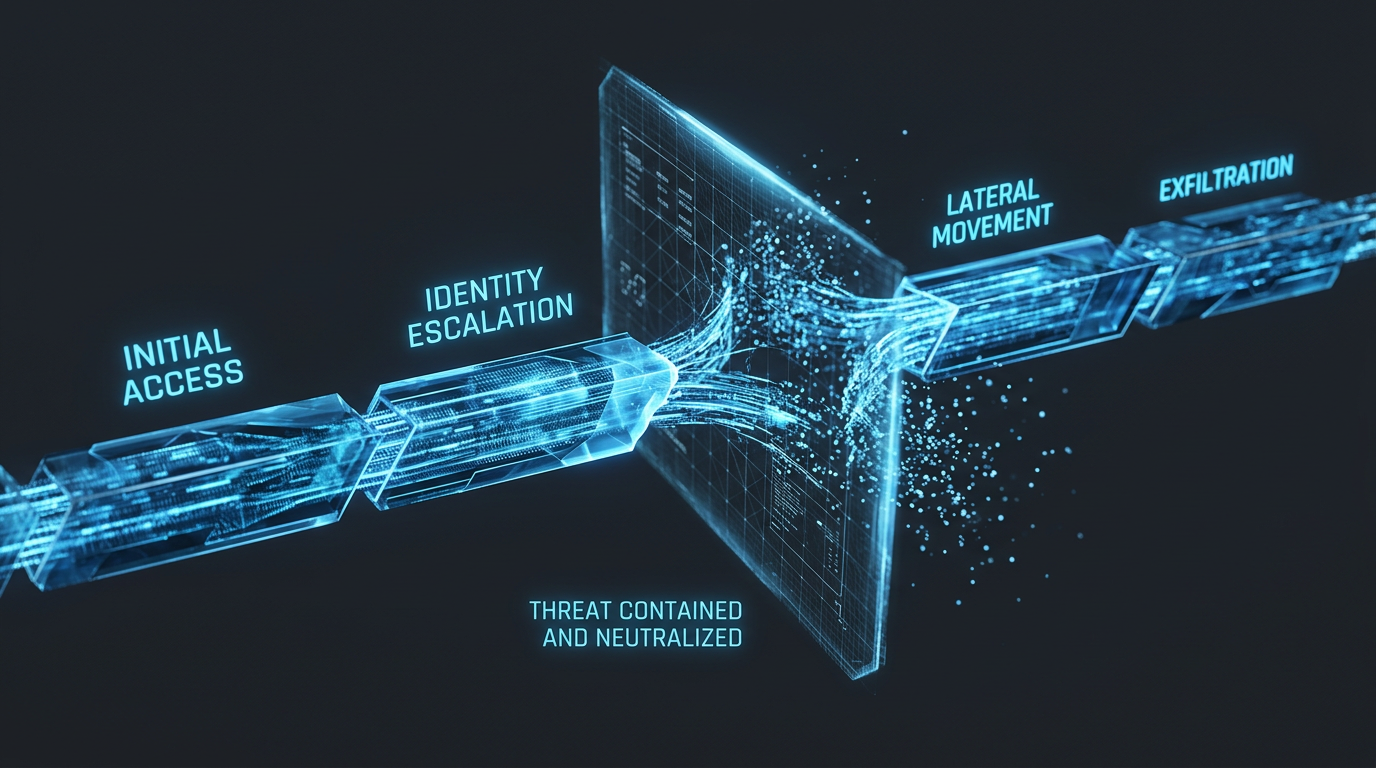
Even though faster ransomware attacks compress the timeline, they are still ultimately sequences of dependent actions. Disrupt one critical link early enough, and the rest cannot unfold at speed. Here is where to focus.
1. Break It at Initial Access
Ransomware groups rely on two primary entry routes:
- Social engineering — phishing, vishing, MFA fatigue, helpdesk impersonation
- Exploiting known vulnerabilities in internet-facing systems
They rarely need exotic zero-days. They need one user to click, one exposed service left unpatched, or one VPN device running an outdated version. To slow the attack chain:
- Enforce phishing-resistant MFA — not just SMS codes
- Patch internet-facing systems aggressively
- Monitor for abnormal login behaviour
- Disable dormant or legacy accounts
2. Break It at Identity Escalation
Once inside, attackers move quickly to expand privileges. Identity is often the fastest escalation path through an environment. Common patterns include token theft, SSO abuse, privilege escalation through misconfigured roles, and service account misuse. To disrupt speed:
- Reduce standing admin privileges
- Monitor for rapid privilege changes
- Enforce least privilege across critical systems
- Alert on abnormal authentication sequences
3. Break It at Lateral Movement
Speed accelerates once attackers can move laterally across your environment. They frequently use legitimate tools — remote management utilities, native administrative binaries, cloud management interfaces — which makes detection harder. Disruption strategies include:
- Segment critical systems
- Monitor remote execution behaviour
- Detect unusual internal authentication spikes
- Restrict east-west traffic where possible
Lateral movement is the bridge between breach and impact. Slowing it creates response time.
4. Break It at Data Access and Exfiltration
Data theft now sometimes precedes encryption — because stolen data creates additional pressure to pay, independent of whether systems are restored. Look for:
-
- Large outbound data transfers
- Mass file compression activity
- Abnormal cloud storage exports
- New outbound connections to unfamiliar destinations
Most organisations focus heavily on endpoint alerts. Fewer monitor outbound data behaviour with equal discipline. Practical steps to close that gap:
-
-
- Enable audit logging in Microsoft 365 and monitor for large file downloads or unusual mailbox exports
- Review Azure or AWS activity logs for abnormal object storage downloads or bulk exports
- Configure firewall alerts for unusual spikes in outbound traffic volume
- Monitor newly created outbound firewall rules
-
On the access control side:
-
-
- Restrict who can export large datasets
- Limit local admin rights that allow bulk access
- Apply data loss prevention (DLP) policies where feasible
- Segment critical data repositories
-
Even basic segmentation in SME environments can slow attackers enough to create meaningful response time. You do not need a national-level SOC to start here — you need logging enabled and someone accountable for reviewing it.
5. Break It Through Governance
When faster ransomware attacks move quickly, small weaknesses become decisive failures. Governance is what determines whether those weaknesses exist in the first place. Ask yourself honestly:
-
-
- Do we know which systems are mission-critical?
- Do we know who is responsible for making containment decisions?
- Do we know which suppliers have privileged access to our environment?
- Do we know how quickly we are required to report an incident under NIS2?
-
If any of those answers are unclear, attackers will exploit that ambiguity. Equally important is decision authority. In a fast-moving ransomware scenario, delays often stem from hesitation. Who has authority to isolate a system? Who informs regulators? Who communicates externally? If those questions are unresolved until an incident unfolds, attackers gain time. Clear accountability shortens reaction cycles.
Building Defensive Discipline in a Faster Ransomware Era

Organisations that fare better against faster ransomware attacks have already reduced friction at earlier points in the chain — tightening access controls, clarifying responsibilities, monitoring data movement, and structuring recovery in advance.
Resilience is built through disciplined governance, realistic preparation, and practical safeguards tailored to your size and complexity. DIESEC supports organisations in doing exactly that through structured Governance, Risk, and Compliance services, targeted Phishing Simulations that address common entry vectors, and modular cybersecurity solutions designed for SMEs.
The objective is straightforward: strengthen the points where ransomware campaigns typically accelerate, so that speed works in your favour rather than against you.
Contact us to learn more.