
Stadler Rail Everest Ransomware: SFr10m Demand Refused
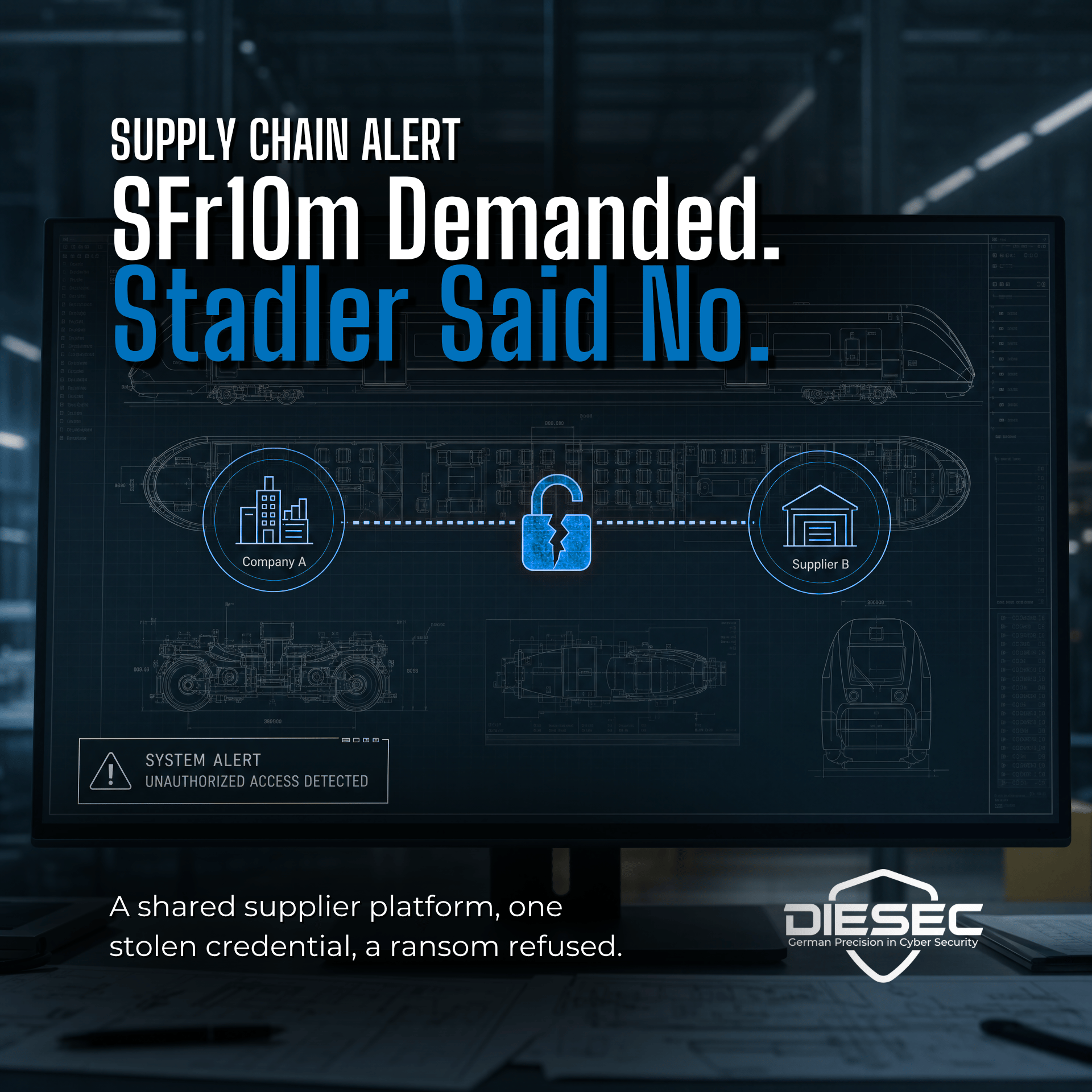
The Stadler Rail Everest ransomware incident shows what a mature extortion response looks like: the Swiss train manufacturer confirmed that the Everest group stole supplier technical data through a shared data-exchange platform and demanded roughly SFr10m (about $12.3M) — and Stadler refused outright, filing a criminal complaint instead of negotiating.
What Happened
Stadler Rail, an 18,000-employee Swiss manufacturer of locomotives, trams, metro trains and railway signalling systems with annual revenue over $4.9 billion, disclosed in mid-July that attackers obtained compromised login credentials for a data-exchange platform it shares with one of its suppliers. Using that access, the Everest group exfiltrated technical information belonging to the supplier — not Stadler’s own systems, and, according to Stadler, not safety-relevant or personal data. Everest then sent an extortion letter demanding 10 million Swiss francs.
Stadler said its own IT infrastructure “were not compromised and remain intact,” and that global production continues as normal. The company’s public statement was unambiguous: “Stadler will not pay any ransom under any circumstances and is therefore not susceptible to extortion.” It filed a criminal complaint with the Thurgau cantonal police. Everest — a financially motivated, Russian-speaking group active since 2020 that shifted from encryption-based ransomware to pure data-theft extortion — has not yet listed Stadler on its leak site. Previously claimed Everest victims include BMW, aerospace supplier Collins Aerospace, and Swedish grid operator Svenska kraftnät.
Why It Matters
This is a shared-platform third-party breach: the attacker never touched Stadler’s own network, only a credential for a system Stadler and its supplier both feed data into. ENISA’s May 2026 NIS360 rail-sector assessment — published two months before this incident — warned that only 35% of railway companies regularly test the effectiveness of their cybersecurity controls, and flagged access-management weaknesses in “complex, multi-user or multi-company operational environments” as the sector’s defining risk. For DACH manufacturing and Mittelstand supply chains built on shared supplier portals and data-exchange platforms, this incident is close to a direct hit on that prediction — and a second confirmed cyber incident at the same manufacturer in six years.
What You Should Do Now
- Inventory every data-exchange platform or supplier portal your organization shares credentials or access with, and confirm each has its own access review cadence — not just your internal systems.
- Verify whether shared supplier platforms enforce MFA independently of your own identity provider, and whether credential compromise on the supplier side can reach your data.
- If no patch or configuration issue applies (this was a credential compromise, not a software flaw), rotate credentials on all shared third-party platforms on a defined schedule, not only after an incident.
- Define your organization’s extortion-response policy before an incident, not during one — Stadler’s fast, public refusal was possible because the position was already clear internally.
If you cannot answer who owns security review for your shared supplier platforms today, that is the gap this incident points to directly.
DIESEC Perspective
This is the fourth distinct trusted-channel compromise DIESEC has tracked in five weeks — after an MSP remote-management tool, a SaaS OAuth integration, and a support-ticketing vendor — each bypassing conventional perimeter defenses by abusing a relationship the victim organization had already extended trust to. The pattern that stands out here is Stadler’s response: a clear, pre-committed no-ransom policy stated publicly within days, not negotiated in the middle of the crisis.
Not sure whether your organization’s supplier and partner platforms have this kind of access-management gap? Contact DIESEC for a rapid third-party access exposure review.
Sources: BleepingComputer | Railway Gazette International
Published: 2026-07-29 | Category: Ransomware & Extortion | ~4 min read