
December 2025 Cybersecurity Round-Up
As much of the Western world shifted into holiday mode this December by slowing operations and thinning staffing levels, adversaries didn’t take time off. If anything, the quiet makes things easier; hackers like the lull. Individuals are more likely to be off their guard too, and small-scale petty cybercrime often increases in December.
December 2025’s cybersecurity roundup covers notable attacks, breaches, and vulnerabilities that made headlines during the month. Some are quiet indicators of larger trends heading into 2026. Whether you’re catching up post-holiday or preparing for Q1 strategy, these are the headlines and insights that matter.
Notable Cyber Attacks and Breaches: December 2025
Before we list this month’s major incidents, a broader shift in government threat perception deserves mention. In late December, senior planners in Germany reportedly concluded that cyberattacks, acts of sabotage, and disinformation campaigns could be early indicators of broader military escalation. According to reporting, Berlin’s confidential Operational Plan for Germany treats cyberattacks as possible precursors to full‑scale conflict.
Incidents previously viewed as criminal or nuisance activity are now being interpreted across Europe as strategic pressure points in an evolving gray‑zone conflict. That shift in threat modeling matters for defenders because it elevates certain classes of attacks targeting election infrastructure, supply chains, or national services from “IT problem” to national security issue.
1. India’s Airport Disruption
In late December, the Indian government confirmed that GPS spoofing incidents disrupted flight navigation systems across multiple major airports, including Delhi, Bengaluru, Kolkata, and Mumbai. No flights were downed, though over 800 flights experienced delays at Delhi airport alone, spurring immediate escalation protocols and public acknowledgment from India’s civil aviation and defense officials.

The risk here reinforces Germany’s warning that attacks on infrastructure, even when non-lethal, may serve as precursors to broader conflict. Here, we see civil aviation targeted in a way that blurs the line between nuisance, warning shot, and test run.
2. Twin Attacks on French Government Services
France faced two separate cyber incidents in December, but they are worth discussing together:
- The Interior Ministry’s email servers were compromised in what officials described as a targeted intrusion.
- Separately, La Poste’s online services were taken offline by a large-scale DDoS attack, which disrupted public access to postal functions.

While unconnected in execution, the timing and targeting reinforce the elevated threat posture facing European governments. These are not opportunistic hits on obscure systems. Rather, they are attacks on core communications and public services, likely meant to undermine trust and probe resilience. With Europe increasingly seen as a proxy zone for international tensions, CISOs in public institutions should be stress-testing everything.
3. Romania’s Water Authority Ransomware Attack
The Romanian National Water Management Authority confirmed a ransomware attack in December that hit its IT systems. Luckily, though, critical water operations were reportedly unaffected thanks to effective segmentation between IT and OT systems. Many national infrastructure operators still operate with porous boundaries between SCADA systems and enterprise IT.
4. Trust Wallet Theft
Moving away from the heavy-government focus in December, more than $7 million in user funds were stolen in a December campaign that exploited a compromised Chrome extension for Trust Wallet. The attacker hijacked the extension to intercept seed phrases and drain customers’ wallets. Trust Wallet announced a reimbursement commitment for verified affected customers, with verification procedures ongoing as of late December.

This attack shows how browser trust remains a dangerously weak link in the crypto ecosystem. These attacks target the interface layer where security expectations are lowest. For enterprise security teams supporting fintech clients or embedded wallets, the lesson is that secure user experience must extend to browser-based session hygiene and extension whitelisting.
5. Cyber Attack on Apple’s Supply Chain Partner
In China, a key Apple assembly partner suffered a cyberattack that affected operations. While details remain limited, the incident is part of a wider pattern of threat actors going “down the stack” to target service providers and vendors whose compromise creates leverage upstream.

It’s a timely reminder that supply chain security isn’t just about who you directly contract with. Major enterprises need to track their Tier 2 and Tier 3 vendors with the same rigor as direct suppliers. Geographic dispersion, low maturity environments, and language barriers often combine to leave gaping blind spots in global supply chains, especially in manufacturing and logistics nodes where cyber hygiene might be lower.
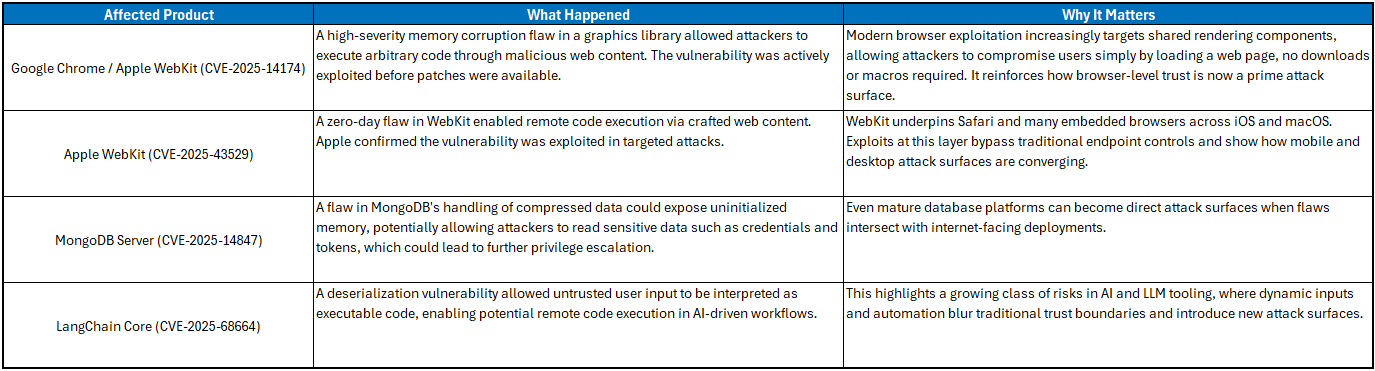
Notable Cyber Vulnerabilities – December 2025
Conclusion
December 2025 showed that cyber threats don’t pause for the holidays. From GPS spoofing at Indian airports to precision ransomware in Romania’s water authority, we’re seeing a rise in targeted disruption campaigns.
Well-resourced attackers exploited gaps between IT and operations, policy and practice, trust and verification. And as Germany’s new defense posture suggests, the line between cyber disruption and geopolitical tension is getting thinner.
Up-to-date threat testing and phishing readiness are the minimum response to a threat landscape that increasingly values precision and persistence. DIESEC continues to help organisations close their cybersecurity gaps with tailored pen testing, phishing simulations, and security solutions that reflect the real-world tactics unfolding every month. As 2026 begins, are your defenses ready?
Contact us now to learn more about how we can improve your cybersecurity posture.