Rethinking Cybersecurity for Lean IT Teams
For lean IT teams at smaller companies, cybersecurity is usually a matter of surviving the daily barrage of threats with the few resources they have. Smaller businesses are now squarely in attackers’ crosshairs, but the solutions available to them still reflect an enterprise mindset with fragmented tools, high overhead, and complexity disguised as sophistication.

Many tools promise coverage of various threat types, but in practice, they deliver more work. It’s time to rethink what effective cybersecurity looks like for resource-constrained teams. Not a diluted version of enterprise-grade tooling, but a model purpose-built for smaller business realities: unified, automated, and intuitive.
The Reality for Lean IT Teams: What They’re Up Against
While SMEs have a smaller attack surface than large enterprises, they still operate in the same threat landscape. The ransomware payload doesn’t care whether your company has 30 endpoints or 30,000. Most lean IT teams at smaller companies are responsible not just for cybersecurity, but also for endpoint management, SaaS oversight, helpdesk tickets, and vendor coordination. This makes it hard to maintain visibility, let alone respond effectively to emerging threats.
Threat actors know all about these struggles. SMEs are increasingly seen as low-effort, high-reward targets. Many don’t have 24/7 monitoring, dedicated incident response, or the time to chase down every alert across disconnected tools. And because many SMEs support remote work and cloud collaboration just like the big players, their exposure through things like phishing, file sharing, and endpoint compromise remains significant.

Also, tooling designed for enterprise SOCs often backfires in SME environments. It assumes staffing, time, and process maturity that just aren’t there yet. The scale of the task is indicated by a recent Mastercard survey that found 46 percent of small businesses (across four continents) have suffered a cyber attack.
Pain Points of Traditional Tooling
Too Many Tools, Too Little Time
Security stacks at larger companies tend to rely on multiple point solutions. There might be one for email, one for endpoint, one for cloud, and so on. For SMEs with limited staff, managing these fragmented tools creates blind spots, missed alerts, and a tangled web of vendors that sap operational focus.
Manual Workload That Doesn’t Scale
Many legacy solutions require constant manual tuning, configuration, and alert triage. For lean IT teams juggling multiple responsibilities, there simply aren’t enough hours in the day to keep up, let alone investigate every low-confidence alert in an inbox full of noise.
Complex Deployments and Hidden Integration Gaps
Traditional cybersecurity tools often assume the presence of dedicated teams for deployment, ongoing maintenance, and integration into broader infrastructure. SMEs rarely have this luxury, which means tools go underutilized, or worse, misconfigured, creating a false sense of protection.
Costs That Outpace Value
Smaller companies are highly cost-sensitive, yet traditional security tools often come with high upfront licensing fees, tiered add-ons, and professional services just to get them working. When budgets are tight, this can lead to underinvestment in key areas.
No Time for the Learning Curve
Even well-designed tools take time to learn. Lean teams can’t afford a steep learning curve just to access basic functionality. Security solutions need to work out of the box, offer clear value immediately, and reduce, not add to, the cognitive load of already overstretched staff.
What a Modern Model Looks Like for Lean IT Teams
Lean IT teams need a model designed around capacity-first protection. This model must fit into their bandwidth and grow with the business.
That starts with platform unification. Instead of juggling siloed products for endpoint, email, cloud, and web, a better approach should consolidate these capabilities into one environment. A single agent, one console, and centralized data flow reduce complexity and help IT teams stay on top of threats without chasing alert noise across five dashboards.
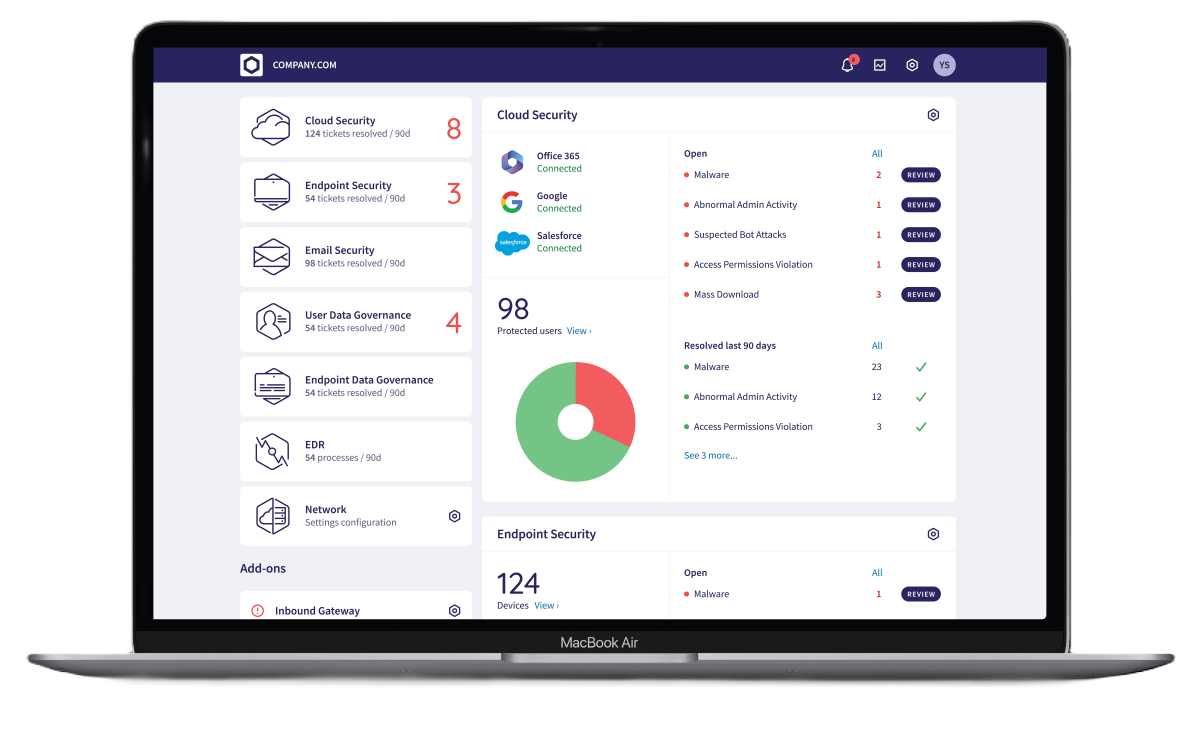
Automation is also non-negotiable. When 95% of threats can be handled autonomously, internal teams are free to focus on the 5% that truly require strategic intervention. That means fewer alerts, clearer priorities, and faster response times.
Scalability and modularity should round out the picture. A security model for lean teams must allow companies to deploy only what they need, then layer on more capabilities as their risk profile or compliance obligations grow. All without having to rip and replace existing infrastructure.
Real-World Outcomes: What Simpler Security Enables
The reclaimed capacity from less wasted manual time means more bandwidth to proactively strengthen posture, build out endpoint baselines, or revisit user access policies that were hastily rolled out under pressure. In short: better security and better IT hygiene for lean IT teams.
Simplified tooling also makes it easier to upskill generalist IT staff. Instead of needing a dedicated security analyst just to interpret alerts, IT teams can confidently handle investigations, thanks to clear context and automation that closes the loop on most threats. This democratization of security reduces dependency on hard-to-find specialists.

Perhaps most importantly, a modular, integrated approach enables security to grow with the business. As smaller companies adopt new SaaS apps, onboard hybrid workers, or expand into new regions, their protection doesn’t lag behind. In other words, security moves at the speed of the company.
Why Our Partnership With Coro Stands Out for Lean IT Teams
Instead of fragmenting security across multiple vendors and agents, Coro offers an all-in-one platform that unifies endpoint, email, cloud, and web security under a single roof. You simply install one agent, use one dashboard, and choose the modules you actually need.
But unification is just the beginning.
Coro automates the remediation of most threats, resolving the majority of alerts without human intervention. That means IT teams aren’t buried in alert fatigue or wasting time jumping between consoles. When something serious does need attention, it gets surfaced clearly, with context and actionable insights.
Coro also eliminates the usual barriers to entry: there’s no heavy integration, no complex deployment cycle, and no need for a team of specialists to manage it. Coro’s approach is designed to scale effortlessly while keeping your operations light and costs predictable.
At DIESEC, we’re proud to partner with Coro and bring its modular cybersecurity approach to small IT teams with big responsibilities. Additionally, through our managed services, you can have your IT team focus on your systems, while we monitor and deal with the threats.