
Top 5 Cybersecurity News Stories July 17, 2026
The five stories in this week’s Cybersecurity News Stories July 17, 2026 share a structural property that distinguishes them from the opportunistic exploitation patterns that characterised earlier months of this year: in each case, the compromised or exposed component is one the organisation has placed into a category other than “security risk.” A remote-access appliance is the perimeter control — it is not expected to carry a CVSS 10.0 zero-day that an unauthenticated attacker can chain into full administrative code execution before the appliance authenticates anyone. Active Directory Federation Services and SharePoint Server are the identity and collaboration backbone — they are not expected to be under active attack before the patches that close the zero-days have shipped. A kernel driver with a valid Microsoft Hardware Compatibility Publisher signature is trusted infrastructure — it is not the mechanism that disables every endpoint protection agent on the network before ransomware encrypts the estate. SAP’s own help portal documentation is configuration guidance — it is not the source of a hardcoded credential that now carries a CVSS 9.1 in a production Commerce Cloud environment. And a Linux kernel hypervisor component is the isolation layer separating cloud tenants — it is not expected to have carried a guest-to-host escape for sixteen years. The pattern this week is not about organisations failing to defend the attack surface they knew about. It is about the attack surface expanding into infrastructure they trusted by design.
1) SonicWall SMA1000 Zero-Day Chain: CVSS 10.0, Actively Exploited, and the CISA Remediation Deadline Is Today
On July 14, 2026, SonicWall published a product notice confirming active exploitation of two zero-day vulnerabilities in its SMA1000 series secure remote-access appliances — covering models 6210, 7210, 8200v, and the Centralised Management Server across all supported hypervisors. CVE-2026-15409 (CVSS 10.0) is a server-side request forgery vulnerability in the appliance’s Work Place interface, the employee-facing remote-access portal. An unauthenticated remote attacker can craft a request that forces the appliance to forward traffic to internal systems, including the Appliance Management Console — the administrator interface that sits behind the Work Place portal and is not normally reachable from the internet. CVE-2026-15410 (CVSS 7.2) is a code injection vulnerability in that Management Console that allows an authenticated administrator session to execute arbitrary operating system commands. Chained, the two give an unauthenticated external attacker full administrative remote code execution: CVE-2026-15409 tunnels a crafted request through the Work Place portal to the Management Console as if the appliance itself were making the request; CVE-2026-15410 takes the resulting authenticated session and executes commands at the operating system level. Rapid7’s managed detection and response team documented active exploitation of internet-facing SMA1000 appliances since at least late June. CISA added both CVEs to the Known Exploited Vulnerabilities catalog under BOD 26-04, with a federal remediation deadline of July 17 — today.
The strategic exposure this creates is not primarily about the technical sophistication of the exploit chain. SMA1000 appliances exist because organisations need a secure, authenticated gateway for remote employees and contractors. The appliance stands at the boundary between the open internet and internal network resources, and the enterprise network’s trust model depends on it performing that boundary function correctly. What CVE-2026-15409 demonstrates is that the Work Place portal — the public-facing component of that boundary — can be used as a request relay to the protected Management Console, turning the organisation’s own perimeter control into an unauthenticated tunnelling mechanism. The pattern repeats a finding established across 2026’s edge device arc: FortiGate in the FortiBleed campaign, SimpleHelp in early July, OPNsense CVE-2026-57155 last week. The device positioned to authenticate and filter remote access is, consistently, the device through which unauthenticated access is being obtained.
The required remediation extends beyond applying the hotfix. SonicWall’s advisory is explicit: if indicators of compromise are present — including suspicious entries in extraweb_access.log or ctrl-service.log, or planted routes in /var/lib/unit/conf.json — the correct response is to re-image hardware appliances or redeploy virtual instances entirely, rotate all user and administrator passwords, and reset TOTP tokens. Patching an appliance that was compromised before the patch was applied does not remove an attacker who has established persistence. For any SMA1000 deployment that has not yet applied hotfix 12.4.3-03453 or 12.5.0-02835, today’s CISA deadline is not a compliance milestone. It is a signal that the window for treating this as a routine patching cycle closed several weeks ago.

Read more on: BleepingComputer · The Hacker News · Rapid7
2) Microsoft’s Record 622-CVE Patch Tuesday Ships Two Exploited Zero-Days in the Identity Layer — SharePoint and AD FS Were Already Under Attack
On July 14, 2026, Microsoft released its July 2026 Patch Tuesday, addressing 622 CVEs — the largest single security update release in the company’s history, surpassing every prior annual total for monthly patch releases. Within those 622 patches are two vulnerabilities confirmed by Microsoft as exploited in the wild before the fixes shipped. CVE-2026-56164 is a missing-authentication vulnerability in on-premises SharePoint Server — covering the Subscription Edition, 2019, and 2016 — that allows an unauthenticated attacker to escalate privileges over the network. Microsoft assigned it a CVSS score of 5.3, a classification that analysis firms including Tenable, Field Effect, and Orca Security have characterised as a material underestimation: the National Vulnerability Database independently scored the same flaw at 9.8. Mandiant and Google FLARE incident responders are credited with the discovery — a detail that signals the vulnerability was found during active attack investigation, not research. Attackers are chaining CVE-2026-56164 with previously disclosed SharePoint vulnerabilities to steal Internet Information Services machine keys, establish persistent footholds on compromised SharePoint servers, and deploy malware — the same campaign structure documented in the 2025 ToolShell intrusions attributed to China-nexus actors. CISA added CVE-2026-56164 to the Known Exploited Vulnerabilities catalog on July 14 with a federal remediation deadline of today, July 17. CVE-2026-56155 is an elevation of privilege vulnerability in Active Directory Federation Services (CVSS 7.8), also confirmed exploited in the wild, that provides a path to AD FS administrator privileges — which in federated identity environments means access to the token-signing certificate used to validate identities across every connected application and service.
The strategic implication of these two vulnerabilities in combination is a function of how on-premises Microsoft infrastructure is actually deployed in European enterprises. SharePoint Server and Active Directory Federation Services are co-deployed by design in a substantial fraction of DACH-region manufacturing, financial services, and public sector organisations — specifically in environments that migrated most workloads to cloud but retained on-premises SharePoint and AD FS as the identity and collaboration backbone for compliance, connectivity, or cost reasons. An unauthenticated attacker who can escalate privileges on SharePoint Server via CVE-2026-56164 has, in observed attack chains, a demonstrated path to IIS machine keys. Those keys enable token forgery — and in federated environments where AD FS is the identity provider, a forged token can authenticate the attacker to any service that trusts the federation, cloud or on-premises. CVE-2026-56155’s compromise of AD FS administrator access reaches the token-signing certificate directly. Together, the two vulnerabilities describe a path from anonymous internet access to authenticated identity across the full federated estate.
The operational challenge is not the patch itself. The patch is available and the remediation path is defined. The challenge is patch velocity in environments that contain legacy SharePoint farms — some dating to 2016 installations — that may not appear in current vulnerability management inventories. AMSI in Full Mode, enabled on all SharePoint servers regardless of patch status, provides a partial compensating control that Microsoft explicitly recommends for CVE-2026-56164 while patch deployment is underway. Any on-premises SharePoint instance with internet exposure that has not been patched should be treated as potentially compromised and its IIS machine keys should be rotated alongside the patch, not after.

Read more on: BleepingComputer · The Hacker News · Tenable
3) GodDamn Ransomware Deploys PoisonX — A Microsoft-Signed Kernel Driver Built to Kill Your EDR Before a Single File Is Encrypted
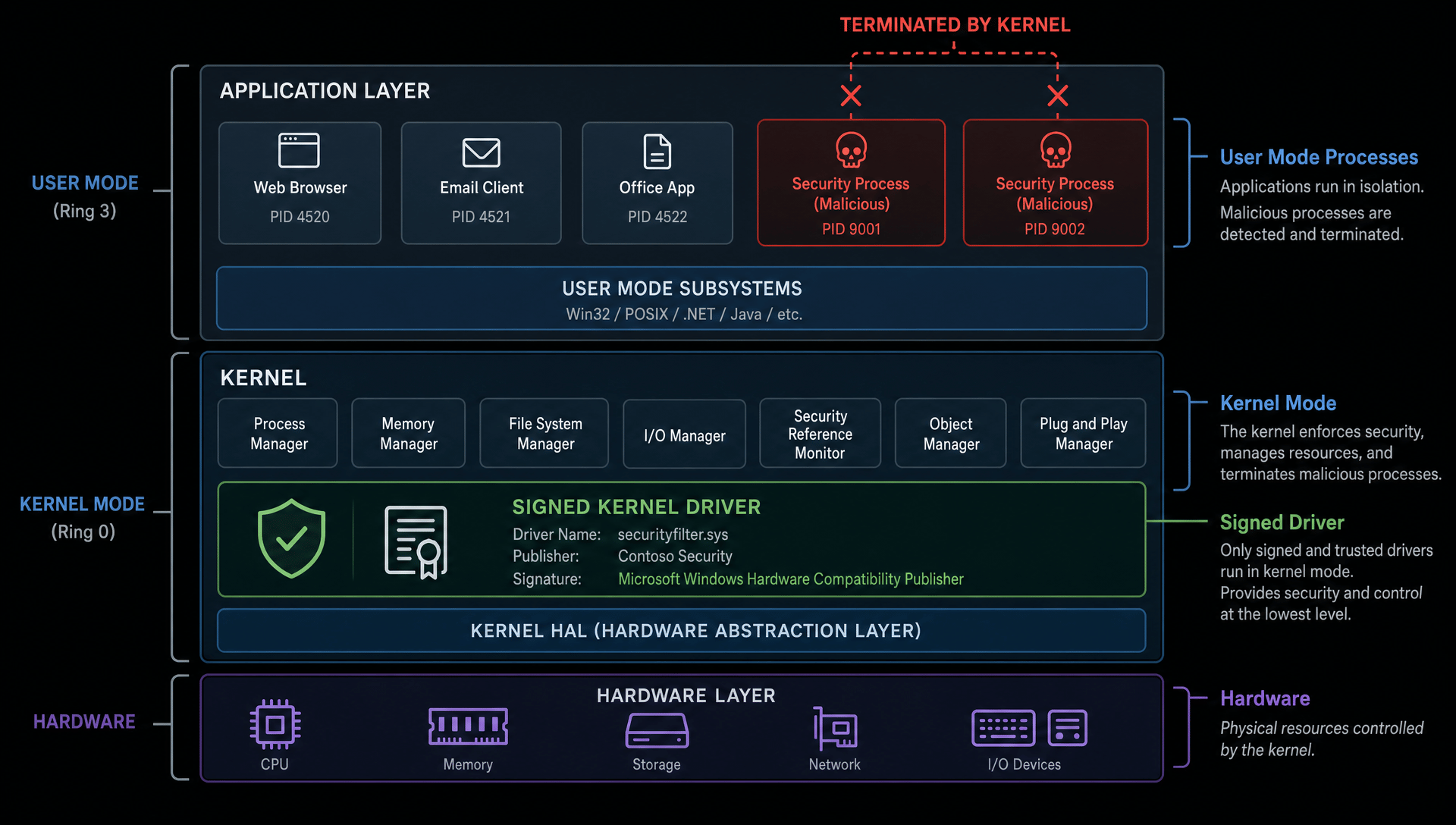
On July 9 and 10, 2026, Broadcom’s Symantec Threat Hunter Team published documentation of GodDamn, a ransomware operation tracked under the threat actor cluster Hyadina — active since March 2022 and operating as an affiliate of The Gentlemen ransomware-as-a-service platform, which had accumulated 478 confirmed victims across 70 countries by June 2026. What distinguishes GodDamn’s current campaign from its prior iterations is the use of PoisonX, a kernel-mode driver carrying a legitimate Microsoft Hardware Compatibility Publisher signature. PoisonX was published on April 7, 2026, by a developer operating under the GitHub alias “oxfemale,” who described it in its own repository documentation as a security research tool for studying process termination at the kernel level. Within weeks, the Hyadina group had integrated it into a component they designate GentleKiller and begun distributing it to affiliates. The mechanism is precise: PoisonX operates at Ring 0 — the kernel layer of the operating system, where it has the highest system privilege — and when it receives specific undocumented IOCTL commands from a loader program, it uses its elevated privilege to remove user-mode API hooks and terminate security processes. In ten confirmed victim environments, PoisonX was deployed, every EDR and antivirus agent was terminated without generating alerts on any remaining monitoring system, and ransomware encryption began only after the protection layer had been completely eliminated across the estate.
The structural implication of PoisonX is an extension of the Bring Your Own Vulnerable Driver pattern that has been documented since 2022, with a specific addition: PoisonX does not require a vulnerable driver. There is no CVE, no unpatched flaw, no misconfiguration. The driver carries a valid Microsoft signature because it passed Microsoft’s Hardware Compatibility testing, and it loads successfully on any modern Windows system with default driver signing policy settings. The abuse occurs because kernel-layer access to process management — designed for legitimate security research — is functionally equivalent to the access needed to eliminate security processes at scale before ransomware deployment. This is the same class of finding as the BlueHammer CVE-2026-33825 discovery documented in last week’s Top 5: the security control itself becomes the attack surface. In BlueHammer’s case, Microsoft Defender was the privilege escalation path. In PoisonX’s case, a Microsoft-signed driver is the silencing mechanism for every Defender and third-party agent on the estate.
The compensating controls that specifically address this class of threat are not additional EDR agents. They are Windows Defender Application Control driver allow-listing — which restricts which signed drivers are permitted to load, regardless of their signing status — and kernel-level EDR protection that itself operates at Ring 0 and can detect the IOCTL patterns that PoisonX uses to issue termination commands. For SMEs and mid-market organisations operating managed endpoint protection through an MSP or a cloud-managed EDR platform, the operational question this story raises is direct: does your endpoint protection deployment include any form of kernel-level driver allow-listing, or does it rely on the assumption that a Microsoft-signed driver is safe to load?
Read more on: The Hacker News · SC Media · Dark Reading
4) SAP July 2026 Patch Day: A CVSS 9.9 Memory Corruption in NetWeaver and a Hardcoded Credential That Shipped in SAP’s Own Sample Code
On July 8, 2026, SAP released its July 2026 Security Patch Day, addressing 16 new security notes. The most severe vulnerability is CVE-2026-44747 (CVSS 9.9), a memory corruption flaw in SAP NetWeaver Application Server ABAP caused by logical errors in memory management that allow an authenticated attacker to trigger unauthorised data access, data modification, or system unavailability. The flaw spans an unusually wide range of kernel releases: KRNL64NUC and KRNL64UC versions 7.22 through 7.22EXT, and KERNEL versions 7.22 through 9.20 — a range that covers both current and legacy NetWeaver deployments at the same time. Two additional critical vulnerabilities were addressed: CVE-2026-27690 (CVSS 9.1), an HTTP request smuggling vulnerability in SAP Approuter — the reverse proxy and authentication gateway used to manage API access for SAP BTP-based applications — and CVE-2026-44761 (CVSS 9.1), a hardcoded credential vulnerability in SAP Commerce Cloud. The source of the hardcoded credentials in CVE-2026-44761 is the detail that carries the most operational weight: the credentials were embedded in sample configuration code distributed through the SAP Help Portal as part of Commerce Cloud quick-start guidance. The vulnerability exists not because a developer made a production coding error, but because configuration documentation that SAP shipped as setup guidance contained OAuth2 credentials that were never intended to reach production — and did.
The breadth of CVE-2026-44747’s affected kernel range reflects the deployment reality of SAP NetWeaver in European enterprise environments. DACH-region manufacturing, financial services, retail, and logistics organisations operate ERP landscapes built on NetWeaver foundations that span multiple generations of kernel versions, constrained by factors that have nothing to do with security: ABAP development certification requirements, the operational risk of modifying live business process systems, and the complexity of coordinating SAP kernel upgrades across systems that carry years of custom development. A CVSS 9.9 flaw that spans from 7.22 to 9.20 is not a vulnerability in a specific, easily identifiable configuration. It is a vulnerability present across the full depth of the deployed NetWeaver estate, including systems that may not appear in current patch management inventories because they have been stable long enough to be treated as managed-and-forgotten infrastructure.
The remediation path for CVE-2026-44761 is more operationally complex than applying a security note. Identifying and rotating credentials that originated in SAP’s own documentation requires organisations to trace configuration history across deployments that may include multiple environments, partner-managed integrations, and system copies taken before the credential was identified as a vulnerability. The correct starting point is not the security note — it is an audit of deployed Commerce Cloud configurations against the specific credential patterns identified in SAP’s advisory, conducted across all environments including development, staging, and production, before any patching activity confirms that a clean starting state has been established.

Read more on: The Hacker News · BleepingComputer · SecurityWeek
5) Januscape CVE-2026-53359: A 16-Year-Old Linux KVM Flaw Lets Guest VMs Escape to the Host on Both Intel and AMD — and It Has Been There Since the Hypervisor Was Introduced
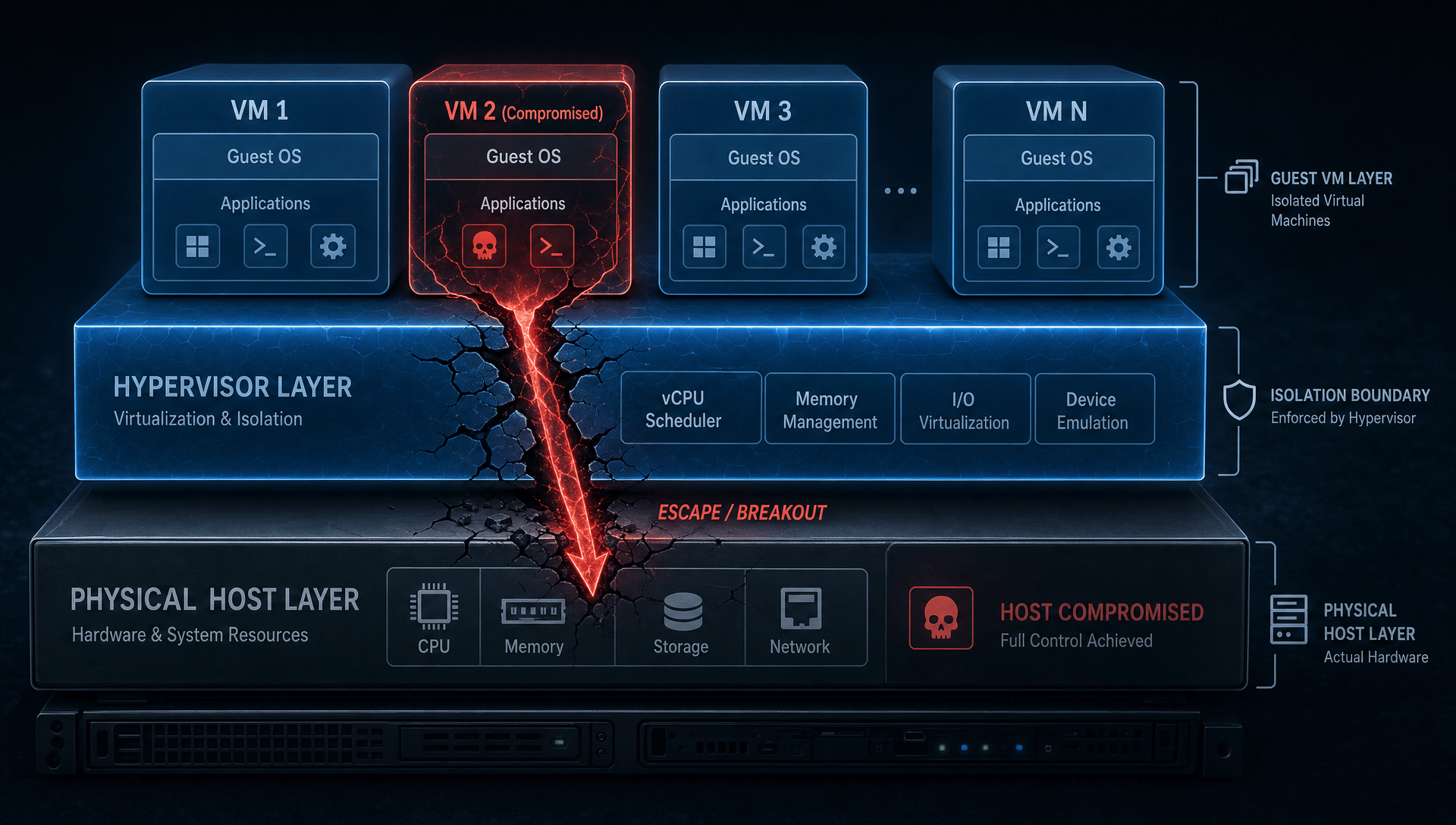
CVE-2026-53359, named Januscape, is a use-after-free vulnerability in the Linux kernel’s KVM/x86 shadow MMU code — a component shared between Intel and AMD implementations of the KVM hypervisor — that went undetected for approximately sixteen years. The vulnerability was discovered by security researcher Hyunwoo Kim and submitted as a zero-day to Google’s kvmCTF controlled vulnerability reward programme, which offers up to $250,000 for confirmed guest-to-host escapes. The technical mechanism: a malicious guest can drive KVM into reusing a cached shadow page that no longer matches the mapping being built, leaving a stale reverse-map entry pointing into memory that KVM subsequently frees. The public proof-of-concept Kim released panics the host, crashing the hypervisor and making it the first publicly documented guest-to-host exploit triggerable on both Intel and AMD x86 hardware simultaneously. Kim separately states — with the full exploit not yet released — that a distinct proof-of-concept turns the same flaw into full host code execution rather than a crash. Stable kernel patches shipped on July 4, 2026, across versions 7.1.3, 6.18.38, 6.12.95, 6.6.144, 6.1.177, 5.15.211, and 5.10.260. For environments that cannot patch immediately, disabling nested virtualisation by setting kvm_intel.nested=0 or kvm_amd.nested=0 eliminates the specific attack path.
The strategic implication of Januscape is a function of what the Linux KVM hypervisor is and where it runs. KVM is the virtualisation layer used by the majority of major public cloud providers — including Amazon Web Services and Google Cloud Platform — as well as virtually every KVM-based VPS provider and on-premises Linux virtualisation environment. In a cloud tenancy model, hypervisor isolation is the control that separates one customer’s workloads from another customer’s workloads on the same physical host. A guest-to-host escape in KVM is not an exploit against the organisation’s own infrastructure — it is an exploit against the shared infrastructure layer that the cloud provider manages, and that the customer has no direct ability to patch or verify. The exposure for organisations running workloads in KVM-based cloud environments is therefore contingent on the cloud provider’s patch status, not the organisation’s own patch cycle. The correct operational response is to verify through the cloud provider’s security advisory channels that the underlying hypervisor infrastructure has been updated — not to apply a kernel patch to a cloud workload, which patches the guest and not the host where the vulnerability resides.
The sixteen-year lifespan of Januscape connects it to a pattern that has been visible across 2026’s vulnerability disclosures: foundational infrastructure components — not applications, not endpoints, not network devices, but the layers those systems depend on — carry long-lived structural flaws that no scanning tool surfaces and no compliance framework requires to be reviewed. The CIFSwitch CVE-2026-46243 documented in June was a 19-year-old Linux kernel flaw giving any local user root access. Januscape is a 16-year-old flaw in the isolation layer separating cloud tenants. In both cases, the flaw was not introduced by a recent change — it was present in the original design and persisted because the code was stable, functional, and reviewed under assumptions that did not include the attack techniques available in 2026. That combination — original design, long stability, high privilege — is now a category of risk that any cloud-dependent organisation should treat as distinct from the vulnerability management process that tracks CVEs from vendor advisories.
Read more on: The Hacker News · SecurityWeek · Ubuntu Security
If this week’s Cybersecurity News Stories July 17, 2026 tells us anything, it’s this:
The five stories in this week’s Cybersecurity News Stories July 17, 2026 describe organisations being exposed through infrastructure they had placed into a category of trust rather than a category of risk. SonicWall’s SMA1000 appliance exists to authenticate remote access — the Work Place portal is the front door for legitimate remote workers, not the entry point for an unauthenticated attacker with administrative code execution. Microsoft’s SharePoint Server and Active Directory Federation Services exist to manage collaboration and identity — they are not expected to be the active attack surface before the patches that close their exploited zero-days have shipped. The PoisonX driver exists with a Microsoft Hardware Compatibility signature because it passed Redmond’s testing process — that signature is not expected to be the mechanism that silences every endpoint protection agent on an estate before encryption begins. SAP’s help portal documentation exists to accelerate deployment — the OAuth2 credentials embedded in that documentation are not expected to become a CVSS 9.1 vulnerability in production Commerce Cloud environments. And the Linux KVM shadow MMU has existed since 2010 — it is not expected to contain a guest-to-host escape that works on both Intel and AMD and that has been exploitable for the entire period since KVM was introduced to the Linux kernel.
The operational implication is about the inventory assumption. Every organisation running a security programme today has a model of its attack surface. That model almost certainly includes the perimeter, the endpoints, the identity layer, the applications, and the cloud workloads. What this week’s five stories collectively demonstrate is that the attack surface has reached deeper than that model — into the appliances that sit in front of the perimeter, the token-signing infrastructure that underpins the identity layer, the kernel drivers that security products trust by virtue of their signature, the vendor documentation that generates production configurations, and the hypervisor isolation layer that separates cloud tenants from each other. None of these appeared in an attack surface model designed five years ago. All of them were targeted this week. The security programme that defends what it knows about, while the actual attack surface continues to expand into what it does not model, is not failing — it is operating correctly within an assumption that is no longer accurate.
For more information, please contact us now!