
ZEGO Cyberattack Insolvency: A Six-Week Shutdown
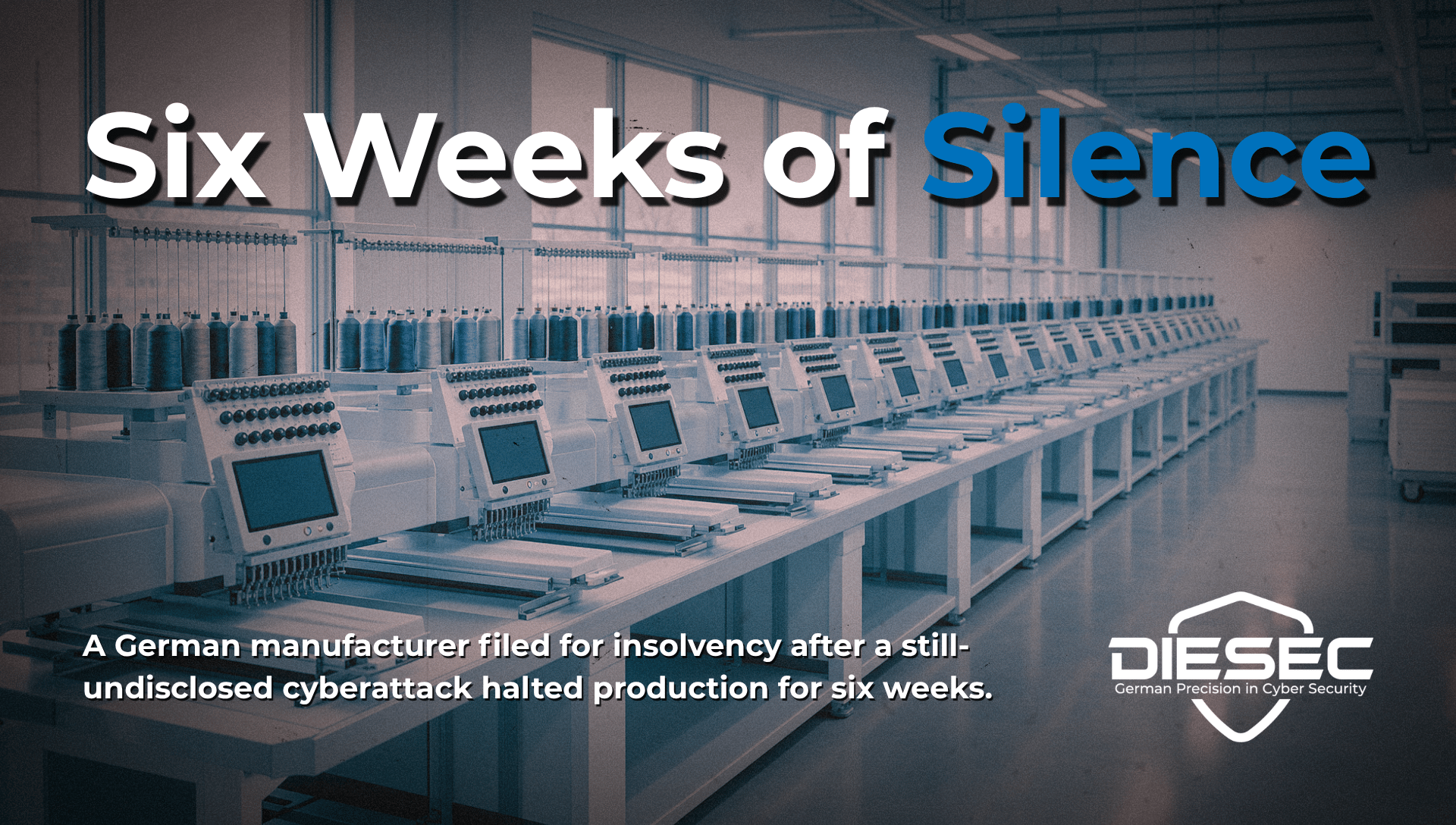
ZEGO cyberattack insolvency is now a real-world case study, not a hypothetical: a 35-year-old German textile finisher in Aschaffenburg has filed for insolvency after a cyberattack in March 2026 halted production for nearly six weeks — and the type of attack that caused it still hasn’t been publicly disclosed.
What Happened
ZEGO Textilveredelungszentrum GmbH, founded in 1990 and employing around 60 people, runs its own embroidery, sewing and printing operations in Aschaffenburg, Bavaria, specializing in workwear finishing plus textile warehousing and logistics. On March 29, 2026, the company was hit by a cyberattack that, according to a statement from managing director Johannes Zenglein, disrupted the business “to an extent we could not fully compensate for despite our greatest efforts.” The result was a production outage of nearly six weeks and financial strain severe enough that ZEGO filed for insolvency, first reported by the Frankfurter Allgemeine Zeitung on July 8, 2026.
The Aschaffenburg local court (Amtsgericht Aschaffenburg) has appointed attorney Maximilian Maierhofer of the law firm Ohly Zöller as preliminary insolvency administrator. Notably, ZEGO’s own statement does not specify what type of cyberattack it suffered — whether it was ransomware, a different form of intrusion, or an operational technology failure triggered by the attack is not independently confirmed in any public reporting to date, including by the specialist outlet it-daily.net, which explicitly noted the gap. The company says it intends to continue operating through the insolvency process, restructure, and preserve jobs.
Why It Matters
ZEGO is not an isolated case. German trade press has flagged a recurring pattern in 2026 of Mittelstand manufacturers whose insolvency was triggered, directly or indirectly, by a cyberattack — including a Chemnitz car dealership (Autohaus Pichel, March 2026) and, in the prior year, Wehrle-Werk AG in Emmendingen. A separate case often cited alongside these is napkin manufacturer Fasana in Euskirchen. According to a 2024 Bitkom study, roughly eight in ten German companies report having experienced a cyberattack, with total annual damage to the German economy estimated at around EUR 267 billion.
What makes ZEGO instructive for DACH boards and risk owners is that the exact attack vector is beside the point. The damage came from six weeks without production — not necessarily from a ransom payment or a confirmed data leak. For manufacturing and production-line businesses where IT and operational systems are tightly coupled and security budgets are limited, a multi-week outage alone can be enough to break liquidity, regardless of whether any ransom was ever paid.
What You Should Do Now
- Review your cyber and business-interruption insurance coverage: does it actually cover six-plus weeks of lost production revenue, or only data-recovery and forensic costs?
- Stress-test your recovery time objective (RTO) for core production-control systems against a realistic multi-week outage scenario, not a best-case tabletop exercise.
- If production and back-office IT share infrastructure or network segments, assess whether that shared blast radius is extending your worst-case outage length.
- Put an incident-response retainer and a customer/supplier communication plan in place now — improvising both mid-crisis, as any affected company must, costs time and relationships exactly when neither can be spared.
DIESEC Perspective
What’s notable about ZEGO is that the attack vector remains undisclosed while the business consequence is entirely clear: six weeks of halted production was enough to force an insolvency filing at a company with a 35-year track record. For board-level risk owners, that reframes the question. The existential risk from a cyberattack is often not the breach itself — it’s how long the production line stays down afterward, and whether the balance sheet can absorb that.
Not sure whether your organization could survive a six-week production outage? Contact DIESEC for a rapid business continuity and incident-response readiness review.
Sources: Frankfurter Allgemeine Zeitung | it-daily.net
Published: 2026-07-10 | Category: Compliance & Governance | ~4 min read