
June 2026 Cybersecurity Roundup: Supply Chain Breaches, Data Extortion, and Critical CVEs
This June 2026 Cybersecurity Roundup lands in a month when the FIFA World Cup kickoff dominated the conversation, with most attention on cyber threats and fraud tied to the tournament. Away from the headlines, though, June’s most consequential incidents ran through SaaS supply chains, ransomware-driven data extortion, and identity compromise. Here’s a roundup of the month’s key cyberattacks and CVEs.
A competitive intelligence platform’s OAuth tokens gave attackers a path into a customer’s CRM without touching that customer’s own infrastructure. A dental benefits administrator and a UK university both had data leaked after ransom demands went unmet. An Indian automotive manufacturer contained a ransomware attack before it reached production. And France’s sovereign government messaging app was breached through a hijacked account rather than a cryptographic flaw. June also brought four critical CVEs across Cisco, Citrix, and Microsoft platforms — one already under active exploitation.
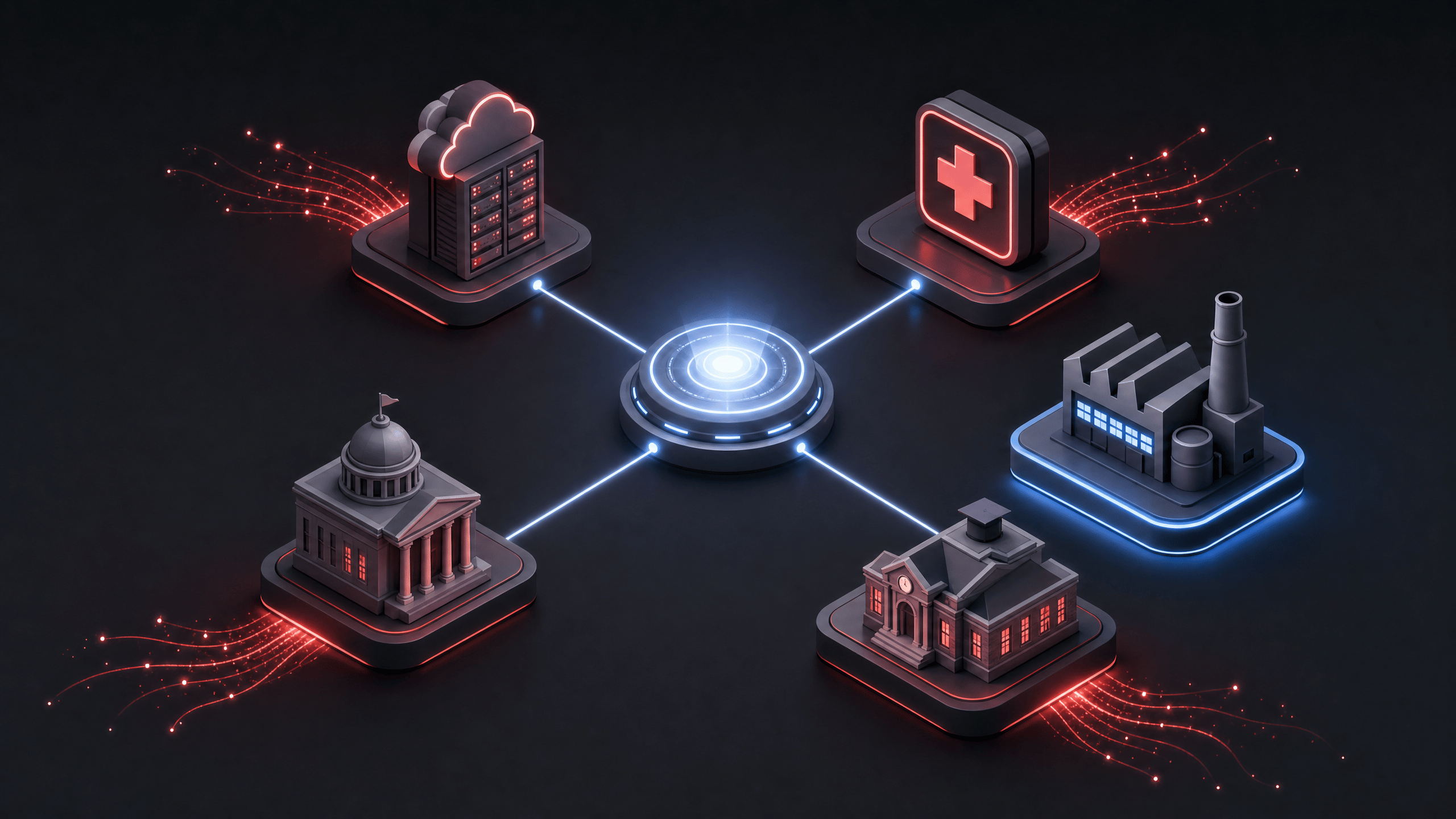
Cyberattacks in the June 2026 Cybersecurity Roundup
Klue Supply Chain Attack
A supply chain compromise affecting SaaS competitive intelligence platform Klue had repercussions across multiple enterprise customers, including LastPass. According to LastPass, attackers compromised Klue and stole OAuth tokens the platform maintained for customer integrations with Salesforce. Those tokens were then used to access CRM environments without directly compromising the affected organisations themselves. As part of its response, LastPass revoked employee access to Klue, rotated exposed API tokens, investigated the scope of the compromise with Salesforce and Klue, and notified law enforcement.
This incident illustrates how SaaS supply chain attacks have evolved. Rather than distributing malicious software updates, attackers increasingly target delegated trust. OAuth tokens effectively allow one platform to act on behalf of another, and once compromised, they can provide legitimate-looking access that bypasses many traditional security controls. For LastPass, that meant exposure of customer names, email addresses, phone numbers, physical addresses, support case information, and sales records — all without a single system of its own being breached.
DentaQuest Data Leak
Dental benefits administration company DentaQuest became the latest victim of ShinyHunters’ prolific operations in June 2026. The attackers reportedly leaked roughly 234GB of stolen information affecting more than 2 million people after ransom negotiations failed.
The breach reinforces just how far ransomware has evolved beyond file encryption. Increasingly, attackers treat sensitive data itself as the primary leverage. Even organisations capable of recovering systems from backups can still face regulatory investigations, notification requirements, reputational damage, and extortion demands once confidential information has been exfiltrated. The priority is detecting and stopping unauthorised access before large-scale data theft occurs — not just recovering afterward.
Bajaj Auto
Indian automotive manufacturer Bajaj Auto disclosed that a ransomware attack affected both the company and its wholly owned subsidiary, Bajaj Auto Technology Ltd. The company said it immediately activated internal response procedures, engaged cybersecurity specialists, and implemented containment measures to reduce operational impact. While the full scope of the compromise has not been disclosed publicly, Bajaj stated that mitigation measures had been successful and that there was no material disruption to production at the time of its announcement.
Manufacturers tend to judge cyber resilience by operational continuity rather than whether an attack occurred at all. In highly connected production environments, preventing every intrusion is unrealistic. The differentiator is whether incident response, network segmentation, backups, and business continuity plans can stop an isolated compromise from escalating into widespread operational disruption. The disclosure also prompted investor concern, contributing to a short-term decline in the company’s share price — a reminder that cyber incidents carry financial consequences even when operations hold up.
Tchap — French Government Messaging App
France’s sovereign government messaging platform, Tchap, suffered a security incident after attackers compromised a legitimate user account through account hijacking. Tchap, developed by DINUM with support from ANSSI, is used by hundreds of thousands of French public sector employees as an ostensibly secure alternative to commercial messaging platforms.
French authorities stated that private, end-to-end encrypted conversations remained protected, since encryption prevented historical private messages from being accessed. Public conversations, however, were potentially exposed. The alleged attacker claimed to have obtained approximately 650,000 messages, information relating to more than 73,000 user accounts, and roughly 13.5GB of documents and media, though officials have not confirmed those figures. Investigators also examined claims that media files could be retrieved through weaknesses in how shared content was handled across the platform. The breach is a reminder that secure platforms can still be undermined through compromised identities: end-to-end encryption protected private conversations, but it could not prevent an attacker from abusing legitimate account access. As organisations adopt encrypted collaboration platforms, identity protection — phishing-resistant authentication, session monitoring, and anomaly detection — becomes just as important as the underlying cryptography.
University of Nottingham
The University of Nottingham confirmed a cyberattack after the ShinyHunters group published stolen information on its leak site. The attackers claimed to have exfiltrated financial information affecting the university’s UK, China, and Malaysia campuses, along with more than 450,000 email addresses and other institutional data. The university acknowledged the breach, took affected systems offline, launched a forensic investigation with external specialists, and notified relevant regulators.
The incident follows a broader trend of universities becoming attractive ransomware and data theft targets, since they maintain extensive repositories of personal information while supporting large, decentralised user populations. For universities — and other large, decentralised organisations — the challenge is balancing openness with strong identity controls, continuous monitoring, and data governance. Once attackers establish a foothold, the scale of accessible information can quickly turn a localised compromise into a major regulatory and reputational event.
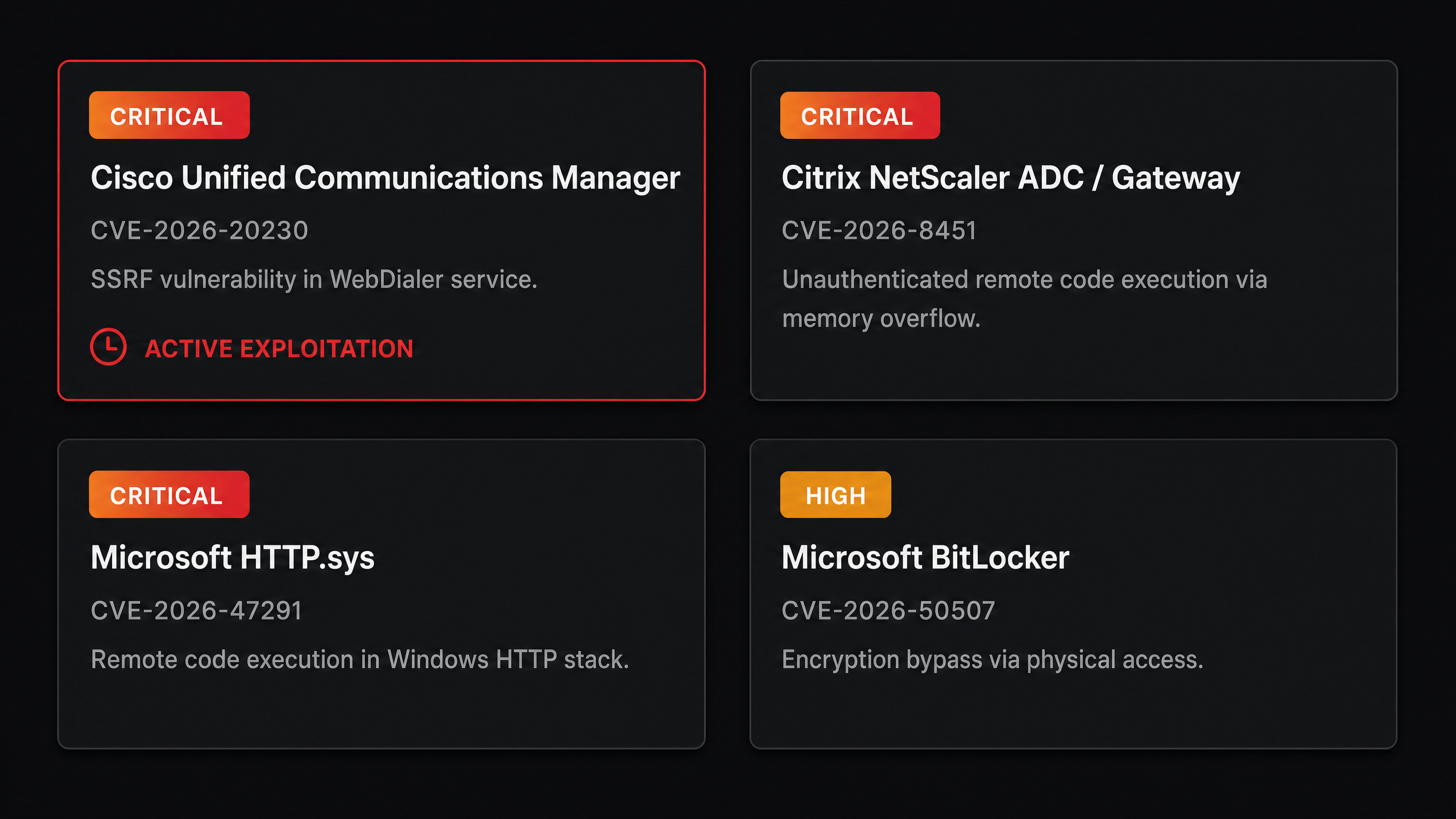
Critical CVEs in the June 2026 Cybersecurity Roundup
This June 2026 Cybersecurity Roundup also flagged four critical CVEs spanning network edge infrastructure, unified communications, and core Windows components — with at least one already exploited in the wild before organisations could patch.
- Cisco Unified Communications Manager (CVE-2026-20230): A critical server-side request forgery (SSRF) vulnerability affecting Unified CM and Unified CM SME. An unauthenticated attacker can send crafted HTTP requests to systems with the WebDialer service enabled, allowing arbitrary file writes that can ultimately lead to root-level compromise. Public proof-of-concept code was released shortly after disclosure, and exploitation was observed in the wild during June. Unified CM underpins enterprise voice and collaboration services across government, healthcare, finance, and large enterprises — the combination of unauthenticated exploitation, public exploit code, and active attacks makes this a high-priority patch. Organisations should disable WebDialer if it isn’t required and apply Cisco’s updates immediately.
- Citrix NetScaler (CVE-2026-8451): A critical memory overflow vulnerability in NetScaler ADC and NetScaler Gateway. Successful exploitation could allow an attacker to execute arbitrary code remotely without authentication on vulnerable internet-facing appliances. NetScaler appliances often sit at the network edge, making them attractive initial access targets — history has repeatedly shown that critical NetScaler vulnerabilities are rapidly weaponised by ransomware groups. Organisations should prioritise patching internet-exposed appliances and monitor for signs of compromise following remediation.
- Microsoft BitLocker (CVE-2026-50507): A vulnerability that allows an attacker with physical access to bypass BitLocker protections under certain conditions and gain access to encrypted data. Although exploitation requires physical access, BitLocker is often the last line of defence for lost or stolen devices. Organisations should review Microsoft’s guidance alongside existing device security controls such as Secure Boot, TPM configuration, and physical asset management.
- Microsoft HTTP.sys (CVE-2026-47291): A critical remote code execution vulnerability in HTTP.sys, the Windows kernel-mode HTTP protocol stack used by services such as IIS and Windows HTTP Server API applications. A specially crafted request could allow remote code execution on affected systems. HTTP.sys vulnerabilities have historically attracted significant attention because they affect core Windows networking components exposed to the internet. Organisations running IIS or other HTTP.sys-dependent services should prioritise patching, particularly on internet-facing servers.

Conclusion
This June 2026 Cybersecurity Roundup makes one thing clear: trusted third-party relationships, identity-based attacks, data extortion, and ransomware all featured prominently in this month’s cyberattacks. A host of newly disclosed vulnerabilities once again highlighted the need for constant vigilance of systems, especially internet-facing apps and hardware.
Whether you’re securing critical infrastructure, a manufacturing environment, or a growing SME, staying ahead of these evolving threats demands a proactive security strategy. DIESEC helps organisations close these gaps through SOC-as-a-Service for continuous monitoring of identity and access anomalies, structured Penetration Testing that covers third-party integrations and internet-facing infrastructure, and tailored Phishing Simulations and consulting designed to strengthen your organisation’s resilience.
Contact us today to learn how we can help improve your cybersecurity posture.