
Swiss Federal SharePoint Breach Hits 200 Accounts
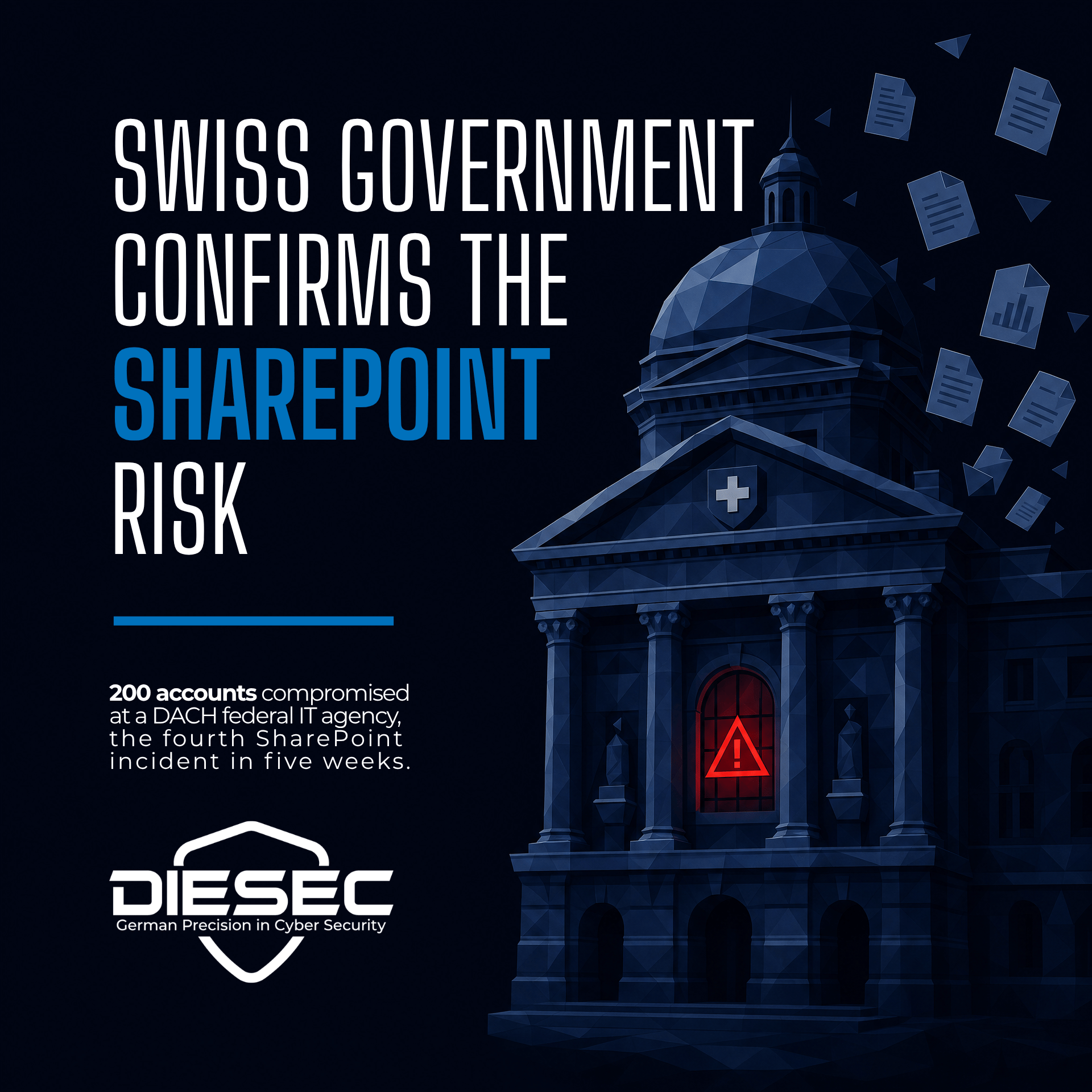
The Swiss federal SharePoint breach compromised roughly 200 accounts at Switzerland’s Federal Office of Information Technology, Systems and Telecommunication (BIT/FOITT), the agency confirmed in early August 2026. It is the first time DIESEC’s ongoing SharePoint vulnerability coverage has connected to a confirmed, named breach inside a DACH government body — not just a vendor advisory.
What Happened
BIT/FOITT detected unusual activity on its on-premises SharePoint environment on Tuesday, July 28, 2026. Investigation confirmed that approximately 200 accounts had been compromised. The agency states the intrusion was “presumably” carried out by previously unknown actors exploiting one of the SharePoint vulnerabilities patched during Microsoft’s July 2026 Patch Tuesday release — the same release DIESEC covered on July 16, which included two SharePoint/AD FS zero-days already confirmed exploited before patches shipped. Which specific CVE was used against the Swiss servers has not been independently confirmed by any source as of this writing, and this article will not speculate further than the agency’s own statement.
BIT/FOITT says that, by policy, no confidential information or particularly sensitive personal data is permitted to be stored on the affected SharePoint platform, and that there is currently no evidence data was exfiltrated beyond the compromised login credentials themselves. As a precaution, the agency is reinstalling the affected servers from scratch, and external access will remain blocked until that work is complete. Switzerland’s Information Security Act (ISG) requires timely incident reporting; BIT/FOITT confirms it reported the breach to the national cyber authority and the State Secretariat for Security Policy within the required deadline.
Why It Matters
The Swiss Federal SharePoint Breach is the fourth entry in a SharePoint exploitation pattern DIESEC has tracked since early July 2026: a disclosure-completeness gap (CVE-2026-45659, July 6), two zero-days exploited before Microsoft’s record-setting July Patch Tuesday shipped (July 16), and machine-key theft that survives patching (CVE-2026-50522, July 23). What changes with this incident is the victim profile — a national government IT agency, not a vendor advisory or an anonymized statistic. For any DACH organization still running on-premises SharePoint, this removes the “it won’t happen to an entity our size” assumption entirely.
The governance parallel to NIS2 is direct. Switzerland’s ISG mandatory-reporting obligation mirrors the incident-notification requirements that now bind roughly 29,500 entities in Germany under the NIS2 implementation law. Organizations in scope should treat this incident as a live example of what a compliant, timely disclosure looks like in practice — and as a reminder that “we patched Patch Tuesday” is not the same statement as “we confirmed no exploitation occurred in the gap before we patched.”
What You Should Do Now
- Confirm your on-premises SharePoint servers are fully current on the July 2026 Patch Tuesday cumulative update, not just scheduled for it.
- Verify: review SharePoint and AD FS authentication logs from mid-July through today for anomalous account activity, particularly logins from unexpected geographies or session tokens issued outside normal business hours.
- If you cannot confirm the patch was applied before any potential exploitation window, rotate SharePoint machine keys as a precaution — patching alone does not invalidate keys stolen prior to the update, per DIESEC’s July 23 coverage of CVE-2026-50522.
- Review whether your incident-reporting workflow under NIS2 (or, for Swiss entities, the ISG) is actually rehearsed and not just documented — BIT/FOITT’s clean, deadline-compliant disclosure is the standard to measure against.
DIESEC Perspective
What stands out here is not the vulnerability class — SharePoint’s July had already made that case three times over — but the disclosure. BIT/FOITT published specifics (detection date, account count, remediation steps, reporting compliance) well within days, while plenty of private-sector breaches of similar scope take weeks to acknowledge publicly, if they ever do. That is worth naming as a governance benchmark, not just a cautionary tale.
Not sure whether your SharePoint environment’s patch status and key-rotation history would hold up to the same level of scrutiny? Contact DIESEC for a rapid SharePoint exposure and patch-verification review.
Sources: BleepingComputer | The Record
Published: 2026-08-12 | Category: Compliance & Governance | ~4 min read